The wooden duck
When my niece was born, I wanted to give her something I had made with my own hands. A pull-along duck, sawn out of a thick piece of oak, with four wheels instead of two feet. I had a pretty clear picture in my head. I had no idea yet how long that picture would keep me busy.
Sketch the duck, saw out the duck, sand the duck endlessly, but then came the biggest challenge: the rolling feet. They had to turn easily and, at the same time, sit so firmly that my niece could never loosen a small part and possibly swallow it.
I made plans, tried things out and threw them away again. To this day I don't know how many hours it took. In the end, the solution was almost inconspicuous: two holes straight through the duck's belly, an aluminium tube in each one, with a thinner tube inside, drilled together with the wheels, glued and fixed on the other side. Then just paint it and let it dry, and it was ready - only to fall on the floor the very first time it was tried out and lose its beak :').
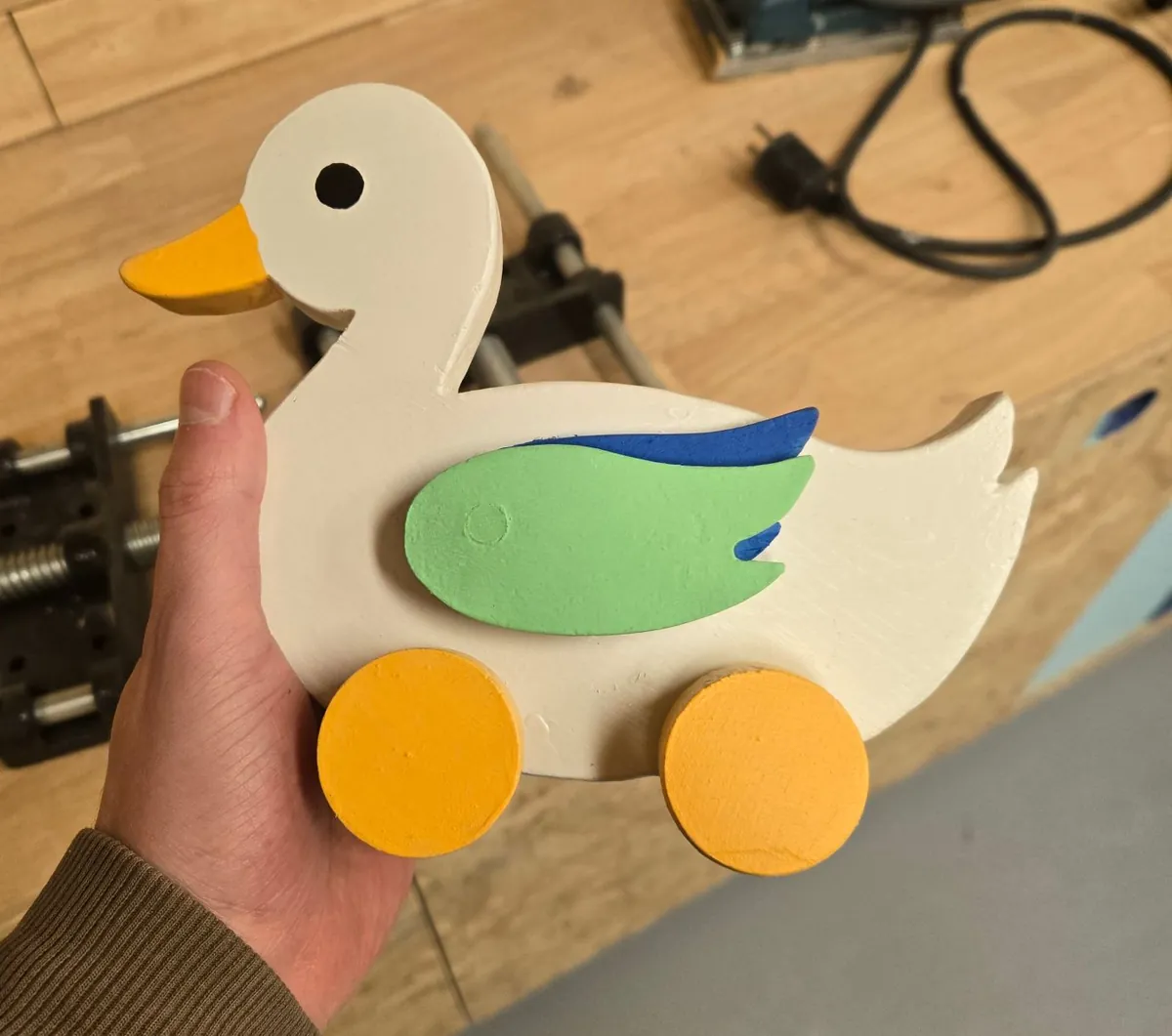
What I remember most clearly, though, is something else: during those hours I completely lost track of time. I didn't need music or any other entertainment. My pulse slowed, my head grew quiet, and at some point it was dark outside.
Maybe you know moments like this too, while gardening, making music, cooking for friends or repairing an old bike. They feel good. There is a lot to suggest that they are good for your biological age as well. Your chronological age counts the years since you were born. Your biological age describes the actual condition of your body, for example how much strain stress and silent inflammation have already put on it. This is exactly where a passion comes in. But why does it restore you so much better than an evening on the sofa?
Why resting is not the same as recovering
After a long day, it is tempting to just collapse: TV on, phone in hand. That feels like a break, and sometimes it is exactly the right thing. Often, though, your mind stays restless. Thoughts about work keep running in the background, and after two hours you hardly feel any fresher than before.
With an activity that fully absorbs you, something different happens. Your attention is entirely on the task, and there is no room left for brooding. Your body gets what it often lacks in everyday life: a real break from alarm mode. A study at Drexel University in Philadelphia showed how well this can work. 39 adults spent 45 minutes painting, drawing or working with clay. Afterwards, the level of the stress hormone cortisol had dropped in three out of four participants. Whether someone had any artistic experience made no difference.
This matters for your biological age, because a permanently raised cortisol level promotes silent inflammation in the body. Read more here (Article: Stress and relaxation).
A passion is therefore more than a pastime. It is a form of recovery that truly brings your mind to rest.
But it is not just about individual hours. A large study from Japan shows what happens when people know what they get up for in the morning.
Ikigai: A word with no English equivalent
Japanese has a word for which there is no exact equivalent in English: ikigai. It roughly means "that which makes life worth living". It can be a task, a hobby, your family or a garden you look after.
Researchers at Tohoku University wanted to know whether this feeling is more than a nice idea. They asked around 43,000 adults in the Ohsaki region whether they had an ikigai and then followed them for seven years.
The result was clear: those who had an ikigai lived longer on average. The difference showed up above all in the heart and circulation, exactly where chronic stress and silent inflammation leave their mark.
A study from the USA shows that this is not a Japanese peculiarity. There, over 6,000 people were followed for 14 years. Here, too, those who saw a purpose in their lives lived longer, in their younger years just as much as in retirement.
Knowing what you get up for in the morning is not a luxury. It goes hand in hand with a longer life.
And there is something that apparently strengthens this effect even further.
Why a shared passion counts twice
Another study from Japan followed around 48,000 people aged 65 and over and looked more closely at which leisure activities went hand in hand with a longer life. The more activities someone pursued, the longer they lived on average. The link was particularly clear for anything done together with others or involving movement, such as a sports club, a hiking group or a neighbourhood project.
This fits with what we know about social relationships. If you share a passion with others, you combine two strong influences on biological age: the feeling of doing something meaningful, and people you look forward to seeing. Read more here (Article: Social connections).
That does not mean a hobby just for yourself does little. The hours in the workshop or at the piano are valuable recovery too. If you share them with others now and then, you simply add something extra. Sometimes it is enough to build a duck for someone or to make a necklace yourself.
But what if nothing comes to mind right now that you are passionate about?
How to find what you are passionate about
You need neither a great life's mission nor an expensive hobby for this. Passion rarely appears at the push of a button; it usually grows out of curiosity that you take seriously. A good starting point is the question of what used to excite you back when nobody expected anything of you. Or what you turn to when you are completely undisturbed for once.
Try things out without committing straight away: a taster course at your local adult education centre (Volkshochschule), an afternoon in a community workshop or a few hours of volunteering a month. A good rule of thumb: if you look at the clock and are surprised how late it already is, you are on the right track.
In the end, what you do matters less than that it gets a fixed place in your life. A passion does not work through a single afternoon, but through you returning to it again and again.
For your biological age, what counts is not how special your hobby is, but how often it makes you lose track of time.
Where the BioAge test helps and where it doesn't
The BioAge test also asks whether you have something you are passionate about and how you spend your free time. It can be a nudge to take an honest look at what is giving you strength right now.
Frequently asked questions about passion, purpose and biological age
Does my work count too if it fulfils me?
Yes. Purpose can arise at work just as much as in a hobby. What matters is that there is still enough room for recovery alongside it.
Is volunteering good for biological age?
There is a lot to suggest it is. An analysis of several studies found that older people who volunteered lived longer on average. Volunteering combines purpose, community and often physical activity too.
Am I too old to start something new?
No. In a study from Texas, people aged between 60 and 90 spent three months learning digital photography or quilting. Afterwards, their memory had measurably improved, more so than with socialising alone without any new challenge.
What if nothing excites me at the moment?
Many people know phases in which few sparks fly, for example during stressful times. Small steps help to reawaken your curiosity. If the lack of interest lasts for weeks and things you used to enjoy no longer bring you any joy, it is worth talking to your GP.