Meeting again at the school reunion
Maybe you know this moment: after years or even decades, there is a school reunion. You walk into the room and instantly it is all back: familiar faces, stories from the playground and school trips, debates about who really got stuck with the worst teacher. So much seems to have stayed the same, and yet after a while a small but telling difference stands out. Everyone is roughly the same age, and still it looks as if years separate them.
One of them looks almost exactly as she did back then. She cycles to work every day, talks about her last mountain hike and comes across as young and full of energy. Another has visibly aged. He talks about back pain, his blood pressure and how even the walk from the car park felt too far.
Of course, this is exaggerated. But at its core it is true, and there is an important distinction behind it: your chronological age only counts the years since you were born. Your biological age, on the other hand, describes the actual condition of your body, for example how well your cells still renew themselves and how elastic your blood vessels are. Among people of the same age, the two can be many years apart. This difference does not just show in the mirror; it can even be detected under a microscope. How can that be?
There are many reasons, but one of them carries particular weight: regular endurance exercise. You do not need a marathon or an iron-clad training plan for it. It is simply about what happens in your body when your heart beats a little faster than usual for half an hour, three to four times a week. And when you follow these processes all the way down to individual cells, a simple question suddenly turns into a fascinating story.
Telomeres: What endurance exercise has to do with the protective caps on your cells
Think of the little plastic tips at the end of a shoelace. As long as they are intact, they stop the lace from fraying. Once they get damaged, the lace gradually loses its protection and starts to fray.
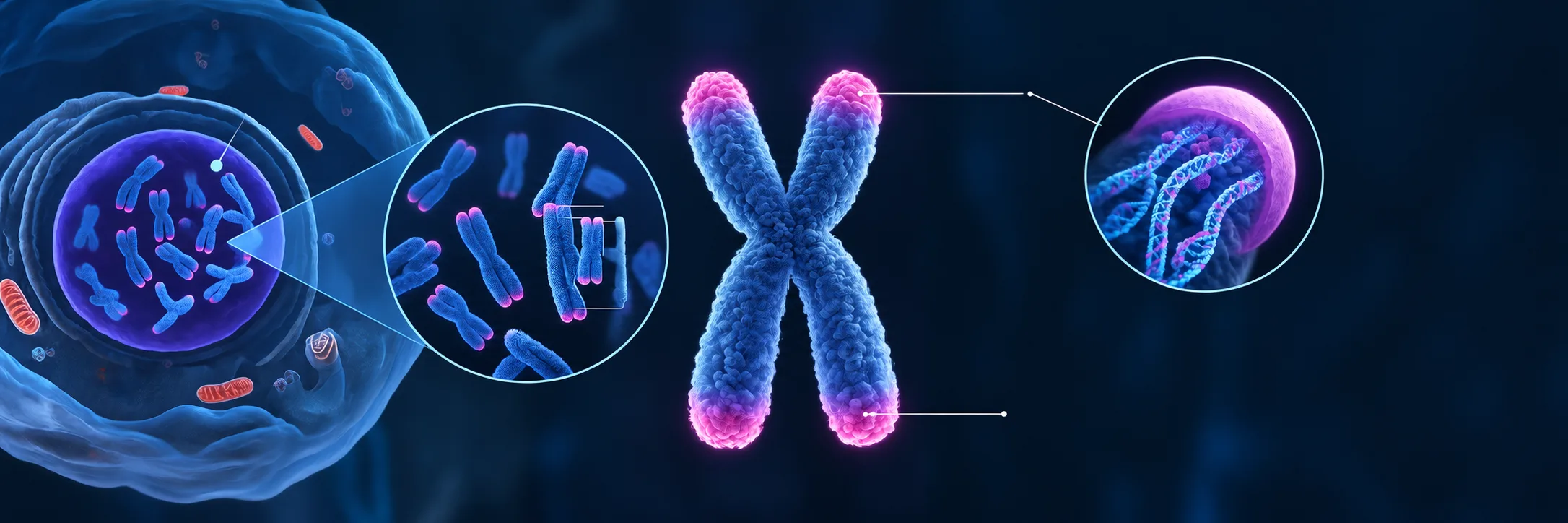
Something very similar exists in almost every one of your cells. Your genetic information is stored in chromosomes, and at their ends there are small protective caps as well: the telomeres. They do not contain any important genetic information themselves. Their job is to protect what lies behind them.
With every cell division, the telomeres get a little shorter. Over time, the chromosomes lose more and more of their protective buffer. At first this is completely normal and simply part of ageing. On average, we lose around fifteen to sixteen of these building blocks per year of life. Once the telomeres are too short, the cell can no longer divide. It stops doing its normal work and instead starts sending inflammatory signals to the surrounding tissue. The more of these "retired cells" there are, the stronger a creeping inflammation in the body becomes, speeding up the ageing process from within.
The key point, however, is this: how quickly this protection fades is not entirely fixed. Certain strains can speed up the process, while other influences can counteract it.
And our body even has its own mechanism for this. An enzyme called telomerase can help maintain the protective ends of our chromosomes and partly rebuild them.
That raises an exciting question: can we influence how active this enzyme is?
This is exactly where endurance exercise comes in.
What happens when 124 people do endurance training for 180 days?
Can endurance exercise really influence what happens to our telomeres and to telomerase? That is precisely the question a research group led by cardiologist Christian Werner set out to answer.
To find out, 124 healthy but previously inactive adults were randomly divided into four groups. The first group ran at an easy, steady pace for six months. The second did interval training, alternating phases of effort and recovery. The third group did classic strength training on machines. The fourth kept to their usual daily routine and served as a comparison.
After six months, participants in all three training groups were measurably fitter. That was hardly surprising. Things got more interesting when the researchers looked at their blood and, with it, at the changes at the cellular level.
In participants who had run regularly or done interval training, telomerase activity had increased two- to threefold. At the same time, their telomeres had become longer. In the strength training group, by contrast, this effect did not appear. These participants had become fitter too, but on these markers of cellular ageing they hardly differed from the group that had not trained.
That by no means makes strength training less important. It simply works through other pathways. Read more here (Article: Strength training).
For the processes examined here, however, a remarkable difference emerged:
endurance training did not just change physical fitness. Its traces could be followed all the way down to the level of the cells.
Why your blood vessels help decide how your body ages
The changes in the telomeres are only one way of looking at how endurance exercise affects biological ageing. Another shows up in our blood vessels.
Picture a garden hose that has spent many summers lying in the sun. Over time the material becomes harder and more brittle. The hose gives less and no longer bends as easily as it used to.
A similar development takes place in our blood vessels as we get older. The vessel walls gradually lose elasticity and become stiffer. As a result, the heart has to work harder to pump blood around the body, and blood pressure rises. But the consequences go beyond the heart. Every organ depends on good blood flow. When the vessels stiffen, less oxygen reaches the brain, the kidneys filter more slowly, and even the skin loses its firmness more quickly. Vascular stiffness is therefore one of the reasons why some people seem biologically younger at 55 than others do at 45.
And here, too, regular endurance exercise can make a difference.
When you move, your heart pumps more blood through your body. The blood flows along the inner walls of the vessels with greater force. The cells lining them sense this stronger flow and respond to it. Among other things, they release nitric oxide, a messenger substance that helps keep the vessels wide and elastic.
If this stimulus is repeated regularly over weeks and months, the condition of the vessels can change. Analyses of several studies show that regular endurance training can measurably reduce vascular stiffness.
This is where the two stories in this article come back together. Endurance exercise does not just affect the performance of your heart and circulation. It influences processes linked to the biological ageing of our vessels and cells.
Telomeres and blood vessels each show the same basic principle in different ways:
how our body ages does not depend only on how much time passes. It also depends on which stimuli we regularly expose it to.
How much endurance exercise do you really need?
The World Health Organization recommends that adults get 150 to 300 minutes of moderate exercise per week. This does not mean hard training, but moving at a pace at which you can still talk but no longer sing, for example brisk walking, cycling or swimming. Spread over five days, that is roughly 30 to 60 minutes a day.
At the cellular level, too, there are signs that consistency is what matters most. In a large US study of almost 6,000 participants, very active adults had telomeres that were on average around 140 building blocks longer than those of people who mostly sat. Converted, this difference corresponds to about nine years of biological ageing.
Another finding of the study is even more interesting: between people who were not active at all and those who exercised only occasionally, there was hardly any difference in telomeres. The link only became clearer among those who were regularly active.
So the decisive step seems to be not from regular to a lot, but from occasional to regular.
Why consistency matters more than peak performance
There is a biological explanation for this, too. Many of the positive responses to exercise do not last after a single workout.
The increased telomerase activity fades again. The same goes for your vessels: after a single endurance session their stiffness can drop temporarily before returning towards its starting level.
The long-term benefit therefore does not come from one particularly hard session, but from many training stimuli repeated over weeks, months and years. An easy run on its own may change little. Once it becomes a habit, your body keeps getting a new stimulus to respond and adapt to.
That is one of the most important takeaways of this article: for your biological age, a single peak performance counts for less than what you do regularly.
So you do not have to achieve anything extraordinary. What matters is that exercise does not remain the exception but becomes part of your everyday life.
Where you stand on endurance
How regularly you exercise is one of the questions in the BioAge test. Together with 24 other questions on exercise, nutrition, life satisfaction, self-care and consumption, it produces an estimate of your biological age and an overview of where you have the most to gain.
Frequently asked questions about endurance and biological age
Does walking count as endurance training?
Yes, if you walk briskly. A good rule of thumb is the talk test: you can still hold a conversation but can no longer sing. Cycling, swimming or climbing stairs count just as much.
What does more for biological age: endurance or strength training?
Both, just in different ways. In studies, endurance showed the clearer effects at the cellular level, while strength maintains muscles, bones and metabolism. The ideal is a combination. Read more here (Article: Strength training).
What if I can't manage 150 minutes a week?
Then less is still worth it. In a large study from Taiwan, people who did just 15 minutes of moderate exercise a day had a clearly lower risk of death than inactive people, and their life expectancy was around three years higher.
Is more training always better?
Up to a point, yes; after that the additional benefit barely grows. For most people, the biggest gain lies in the step from occasional to regular, not from regular to a lot.
How quickly does endurance training work?
Your blood vessels respond after just a few weeks of regular training. In studies, changes at the cellular level appeared after about six months. As with everything, what counts is what you keep up in the long run.